
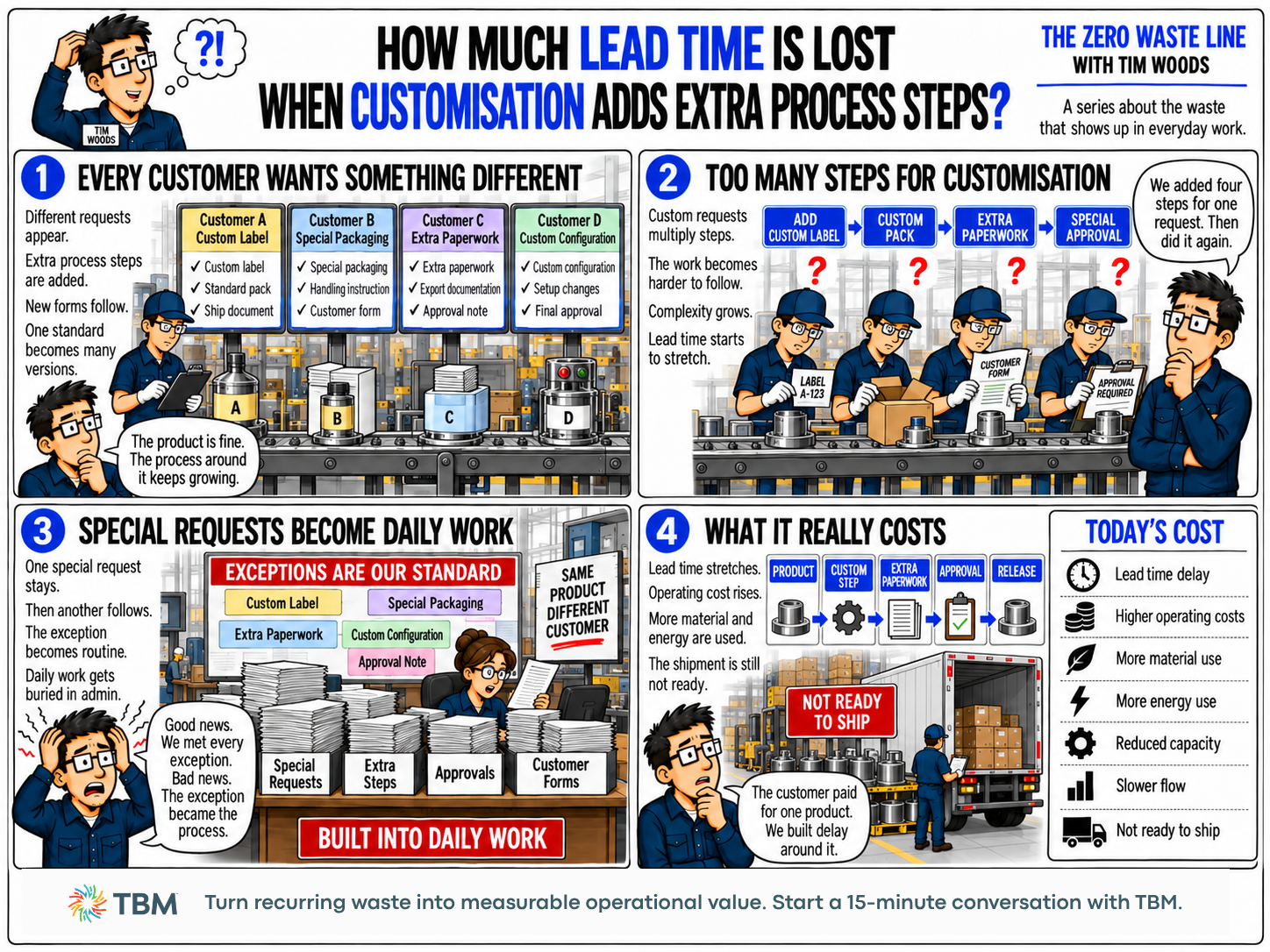
A customer asks for a different label. Another wants specific packaging. A third requires additional paperwork before an order can leave the site. None of these requests seems particularly significant on its own, and in many manufacturing businesses, accommodating them is simply part of serving the customer. The difficulty begins when every request creates another permanent step in the process.
Over time, production teams can find themselves working through an increasingly complicated mix of labels, forms, approvals, packaging variations and customer specific instructions. The product itself may remain relatively straightforward to manufacture, but everything surrounding it becomes slower and harder to manage. This is how customer customisation can create overprocessing in lean manufacturing and highlight broader lean manufacturing waste across the value stream.
Overprocessing is one of the seven types of waste in lean. It refers to work that consumes time, labour or resources without creating additional value for the customer. Some examples are easy to recognise, such as processing a component to a higher tolerance than required or repeating an inspection when the same information has already been verified elsewhere. This is often described as overprocessing lean or overprocessing manufacturing when it shows up on the shop floor.
Other forms are much harder to see. An approval introduced years ago may still sit within the process even though the original reason for it has disappeared. A customer form may be completed manually using information already captured elsewhere. A special packaging instruction may require additional handling every time an order passes through the factory. None of these activities necessarily looks wasteful in isolation, but together they can add considerable time and complexity to the process and contribute to lean manufacturing waste.
Manufacturing processes rarely become complicated overnight. Complexity tends to accumulate gradually as individual customer requirements are added to an existing way of working. One customer asks for a specific label, so another task is introduced. Another requests a different packaging configuration. A third needs a separate certificate or approval before shipment.
Each request may be entirely legitimate, but as more variations enter the operation they often create additional work for planners, operators, quality teams, warehouse employees and supervisors. Eventually, the business may be managing dozens of slightly different process routes around products that are fundamentally similar.
The important question is not whether customer customisation should exist. In many industries it is essential and can be an important source of competitive advantage. The question is whether every form of customisation needs to create a different process around the product—and whether that difference results in overprocessing in lean manufacturing.
One of the challenges with overprocessing is that it quickly becomes familiar. A temporary workaround becomes a permanent instruction, a customer specific form becomes part of the standard documentation, and an extra approval remains in place because nobody has revisited why it was introduced.
As employees learn to work around the complexity, those activities begin to feel like normal parts of the job. This is often where overprocessing in lean manufacturing becomes difficult to identify. The process may be functioning exactly as designed, while still creating considerably more work than the customer actually values—classic overprocessing lean hidden within routine tasks.
The cost is often spread across the operation rather than appearing in one obvious place. Operators spend additional time handling products, planners manage more variations, quality teams review more documentation and supervisors spend time following up approvals or resolving exceptions. Each activity may take only a few minutes, but repeated across hundreds or thousands of orders, the impact becomes significant.
One of the clearest signs of overprocessing appears when production has technically finished the product, but the order still cannot leave the site. Documentation may be waiting for approval, a special label may still need to be printed, a packaging requirement may not have been confirmed or additional information may need to be entered into another system.
From the customer perspective, the distinction does not matter. The product has not arrived. This is why overprocessing has such a direct relationship with manufacturing lead time. Every additional step creates another opportunity for delay, queueing, mistakes and rework. Such overprocessing manufacturing issues often sit outside core production but dominate total lead time.
Adding more controls and more process does not automatically create greater reliability. In some cases, it simply creates more places where flow can stop. A production line may be performing well while the total order lead time continues to increase because of the activities surrounding production rather than production itself.
The effect of overprocessing is not limited to administration. Every additional activity consumes some combination of labour, equipment, material, floor space or management attention. Operators spend time changing labels or packaging, planners manage additional variants, quality teams review more documentation and warehouse teams may hold completed products while waiting for final requirements to be satisfied.
This is capacity that already exists inside the operation, but it is being consumed by additional process. That becomes particularly important when a factory believes it needs more people, another shift or new equipment to meet demand.
Before adding capacity, manufacturers should understand how much of their existing capacity is being absorbed by work that may no longer be necessary. Removing unnecessary processing can release time and resources without increasing the physical size of the operation—directly attacking types of waste in lean.
Customer customisation itself is not waste. Many manufacturers compete precisely because they can respond to different customer requirements. The opportunity lies in separating the requirement itself from the way the organisation chooses to fulfil it.
There is an important difference between customising the product and customising the entire process around the product. A customer may genuinely require a specific label, certificate or packaging format, but that does not necessarily mean the order needs a completely different process route, multiple additional approvals or repeated manual data entry.
Manufacturers can often maintain customer choice while simplifying the process behind it. Common variations can be grouped into standard routes, duplicated approvals can be removed, documentation can be consolidated and clearer rules can be established for genuine exceptions. The objective is not to provide less value to the customer. It is to remove work that does not create more value and reduce overprocessing in lean manufacturing.
A useful starting point is to follow an order from release through to shipment and look closely at every activity surrounding the product. At each stage, ask what would happen if that activity disappeared.
If removing the step would compromise safety, quality, regulation or something the customer genuinely values, it probably needs to remain. If the activity exists mainly because it has always been part of the process, it deserves closer examination.
Customer specific approvals, duplicate paperwork, repeated data entry, unnecessary inspections, packaging variations and manual checks are good places to start. Manufacturers should also look closely at where orders regularly wait. If completed products repeatedly sit while paperwork, approvals or information catch up, the real constraint may not be production capacity at all, but overprocessing manufacturing tasks that have accumulated over time.
Overprocessing rarely arrives as one major operational problem. It builds gradually through another form, another approval, another customer request or another task added to the routine. That is precisely why it can remain inside a process for years without attracting serious attention.
For manufacturing leaders looking to improve flow, reduce lead time or release capacity, the opportunity is often found by looking beyond the production step itself. How many activities are genuinely necessary? How many remain because of historical decisions? How many customer specific requirements could be handled through a common process rather than creating another exception?
Before adding more people, equipment or shifts, it is worth asking whether the existing operation is simply doing more processing than the customer actually needs—an avoidable form of lean manufacturing waste within the broader types of waste in lean. At TBM, we work alongside manufacturing teams to identify recurring waste, simplify flow and release capacity already present within the operation.