Overproduction is one of the seven wastes of Lean manufacturing, and many practitioners consider it the most damaging of them all. It happens whenever a line produces more than the customer has ordered, or produces it earlier than it is needed. The machine is running, the schedule looks full and the team feels productive, yet the extra output creates no value for the customer. Overproduction in lean manufacturing is dangerous precisely because it feels like progress. It ties up cash, fills space, and quietly generates several of the other wastes while hiding the problems that caused it.
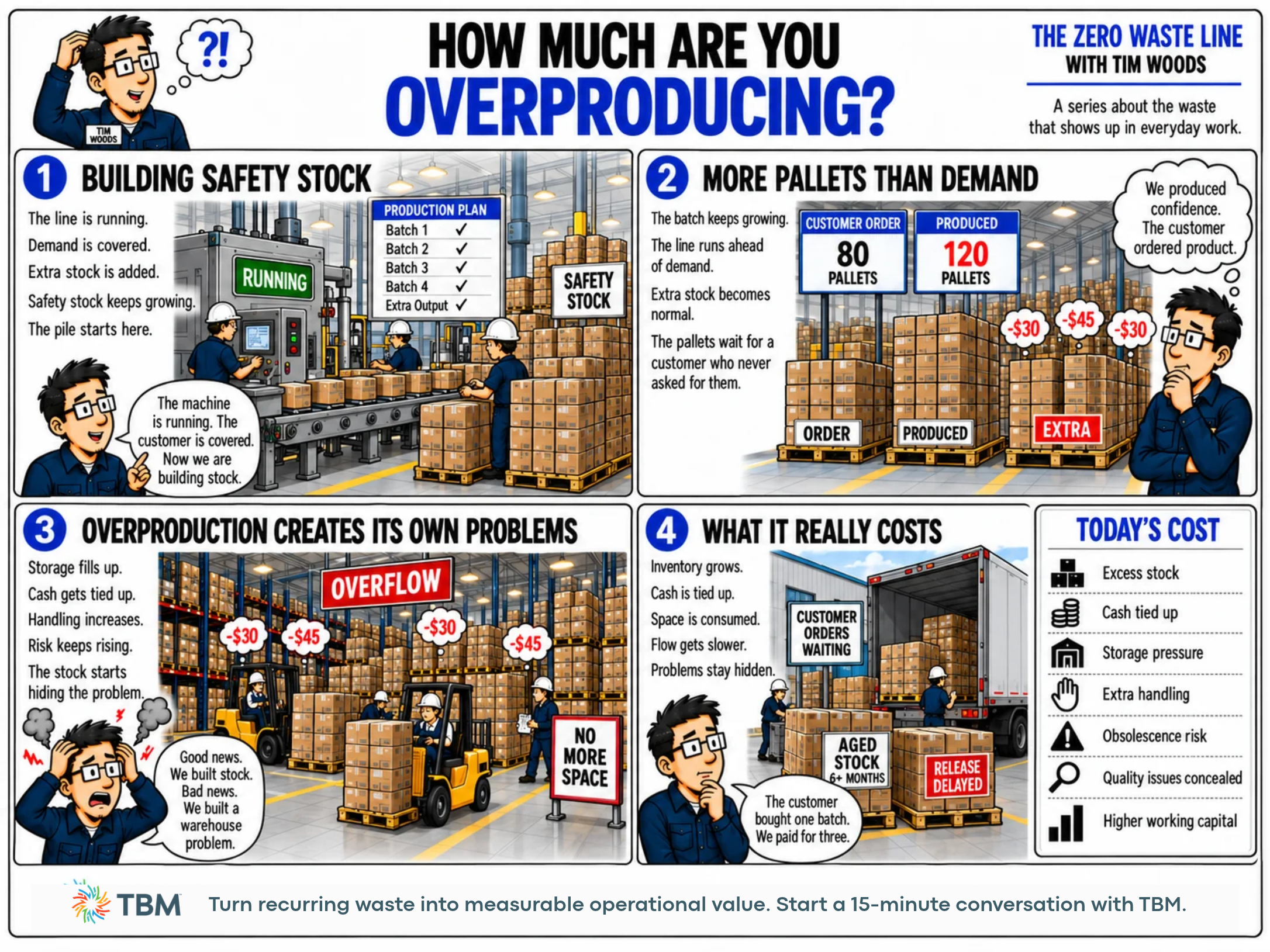
Overproduction rarely starts as a mistake. It often begins as caution. Demand is covered and the line is running well, so the team keeps producing to build a little safety stock. Then the safety stock keeps growing. The machine is busy and the customer is covered, so nothing looks wrong. From the perspective of the process, though, the operation has stopped making what was ordered and started making what might be needed. That shift, from producing to demand to producing to reassurance, is where overproduction in lean manufacturing takes hold.
The clearest sign is simple to measure. The customer orders eighty pallets and the line produces one hundred and twenty. The extra forty were never requested, yet they consume the same materials, labour, energy and machine time as the pallets that were. Those pallets then wait for a customer who may never ask for them. Produced ahead of demand, they tie up working capital while they sit, without reducing any real risk.
Common causes include large batch sizes, long or difficult changeovers that tempt teams to run while the machine is already set up, production planned to a forecast rather than to real consumption, and local targets that reward machine utilisation or output volume over flow. When a line is measured on how busy it is, keeping it running becomes the goal, even when no one has ordered what it makes. These incentives are frequent sources of overproduction in lean manufacturing, and they are the first place to look when considering how to reduce overproduction in production.
Overproduction is treated as the most serious waste because it generates the others. The surplus becomes excess inventory. That inventory needs transport to move and space to store, which creates handling and motion. Most damaging of all, a large stock of finished goods hides problems. If a batch contains a defect, it may not surface until the whole batch is worked through weeks later, by which point the cause is long gone. Producing to demand exposes issues quickly. Producing ahead of it buries them under pallets. This is why reducing overproduction often does more for quality and flow than any single fix aimed at those symptoms.
It is tempting to treat overproduction by simply cutting inventory, but stock that is removed without addressing why it was built will return. The stronger approach is to make the operation able to produce closer to demand: level the schedule so volume and mix are steadier, shrink batch sizes, shorten changeovers and improve process reliability so the team no longer needs a large cushion of stock to feel safe. These actions target overproduction in lean manufacturing at its source rather than managing its symptoms.
When demand rises or delivery feels at risk, the instinct is often to build more stock as insurance. Sometimes that is justified, but first it is worth understanding what the existing overproduction is already costing in cash, space and concealed quality problems. A growing pile of finished goods can look like security while it is actually hiding an unreliable process. Recovering the capital and capacity tied up in surplus stock is frequently a bigger and faster win than building still more of it.
Overproduction is easy to miss because it looks like productivity. A busy machine, a full warehouse and a schedule that is always running can feel like a healthy operation, even as cash is consumed and problems are buried. The next time the line is producing ahead of demand, ask not only how much is being made, but who ordered it and what the surplus is really costing. That question is where reducing overproduction in lean manufacturing begins, and where a busy factory starts to become a productive one.
If overproduction has become normal in your operation, or you want to understand what the surplus is really costing in cash, capacity and quality, talk to TBM. We can help quantify the impact and identify where that tied-up value can be recovered. Start a conversation with TBM.