The cost of poor quality is everything a business spends because work was not done right the first time: the labour, material, machine time, overtime and delivery performance lost to scrap, rework, repairs and returns. Defects are one of the seven wastes of Lean manufacturing, and they are the waste most operations believe they already have under control, because inspection catches them before they reach the customer. The problem is that every caught defect is still paid for twice, once to make the part and again to fix it, and a plant can become very good at finding defects without ever getting better at preventing them.
The simplest way to see the problem is first pass yield, sometimes called first time yield: the share of parts that pass a process step correctly the first time, with no repair. When first pass yield is low, the cost of poor quality spreads quietly across the whole operation.
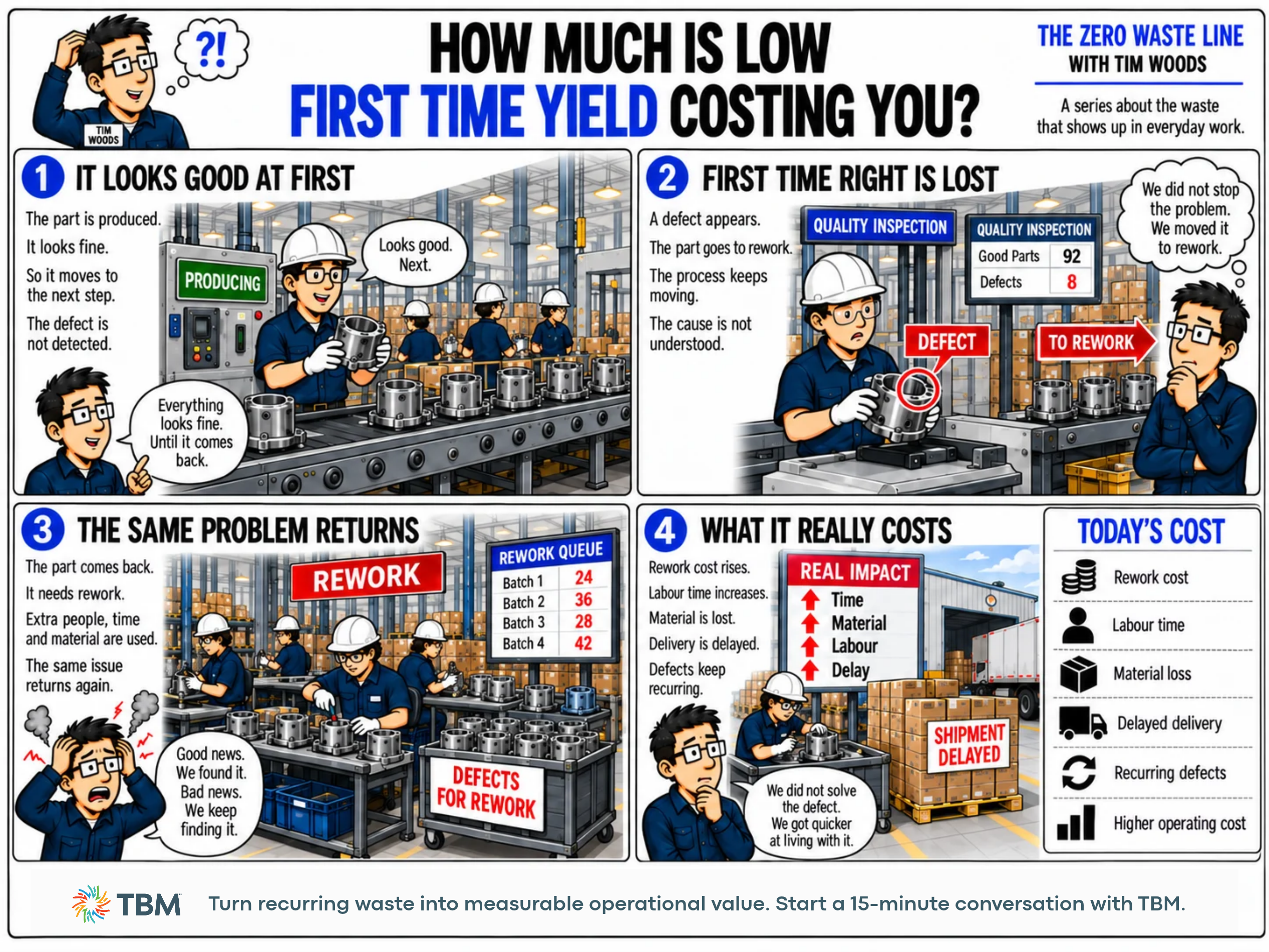
The part is produced and looks fine, so it moves to the next step. Nobody at the first station has a reason to stop it, which means the defect is not detected where it was made. From the operator’s point of view everything is running to plan, and the problem only becomes visible later, when the part comes back.
Further down the line, quality inspection catches the fault. The board shows 92 good parts and 8 defects, the defective parts go to rework and the process keeps moving. On paper the system worked, because the defect was found before it reached the customer, but nothing was learned about why it happened. The problem moved to rework, and its cause stayed on the line.
A week later the rework area is busy again. Four batches send 24, 36, 28 and 42 parts back for repair, 130 parts in total, many with the same fault, and extra people, time and material go into making the same parts twice. The team is good at fixing defects, and that is part of the trouble: the faster rework becomes, the easier it is to live with the cause. The defect has been found, but it keeps being found.
Common causes include work methods that vary from shift to shift because there is no clear standard, changeovers and set-ups without a first-piece check, equipment that drifts out of condition, material that varies between suppliers or batches, and inspection placed at the end of the line instead of at the point where the defect is made. Targets that reward output volume over first pass yield make the problem worse, because stopping to fix a cause always looks more expensive than passing the part on.
A first pass yield of 92% sounds respectable, but yields multiply across a process. If a part passes through four steps, each with a 92% first pass yield, the share that gets through all four without being touched twice is 0.92 × 0.92 × 0.92 × 0.92, or about 72%. This is rolled throughput yield, and it shows that more than a quarter of what this line makes has been reworked somewhere along the way, even though no single board looks alarming.
ASQ splits the cost of poor quality into internal failure costs, which arise from defects found before the customer receives the product, and external failure costs, which arise from defects found afterwards. Internal failure costs include scrap, rework, re-inspection and the overtime needed to recover the plan. External failure costs include warranty claims, returns, complaints and the damage a late or faulty delivery does to the relationship with the customer.
Because these costs are spread across labour, material, overtime, expediting and delivery performance, they rarely appear as a single line in the accounts. In ASQE’s 2025 cost of quality research, only 31% of respondents said they fully understand the impact of quality costs on their organisation. Quality pioneer Armand Feigenbaum called the capacity lost to rework and repair the “hidden plant” and estimated it at 15 to 40% of a plant’s capacity. That figure is an estimate rather than survey data, but it explains why a plant with a busy rework area can feel short of capacity while its machines are not fully used.
The natural response to rising defects is more inspection: another check, another inspector or a wider sample. That improves detection, and it can be the right short-term move to protect the customer, but it does nothing for first pass yield, because every part that is caught still had to be made, inspected, reworked and inspected again. The stronger approach is to treat each recurring defect as a process problem with an owner and a deadline, stabilise the method with standard work, keep equipment in condition and make sure the people closest to the work can stop and raise a problem without being seen as slowing the line down.
When quality problems put delivery at risk, the instinct is to add capacity around them through an extra rework shift, more overtime or another inspection station. Before doing that, it is worth measuring how much labour, machine time and material rework is already using. Large batches make this harder, because a defect can sit inside a batch for weeks before anyone finds it, as we described in our article on overproduction in lean manufacturing. Recovering the capacity tied up in making parts twice is often a faster and cheaper route to better delivery than adding people to repair them.
Defects are easy to live with because the system catches them. The board shows mostly good parts, the rework team is skilled and the customer usually gets the order, even if it arrives a little late. Yet every repaired part has used the line twice, and every defect that comes back is proof that the cause is still there. The next time a defect is found, ask not only how quickly it can be fixed but why it happened and whether it will happen again. That question is where reducing the cost of poor quality begins, and where a plant stops getting quicker at living with problems and starts getting parts right the first time.
If rework has become part of normal operations at your site, or you want to understand what low first pass yield is really costing in capacity, labour and delivery, talk to TBM. We can help you quantify the cost of poor quality and find where getting it right first time will release the most value.