
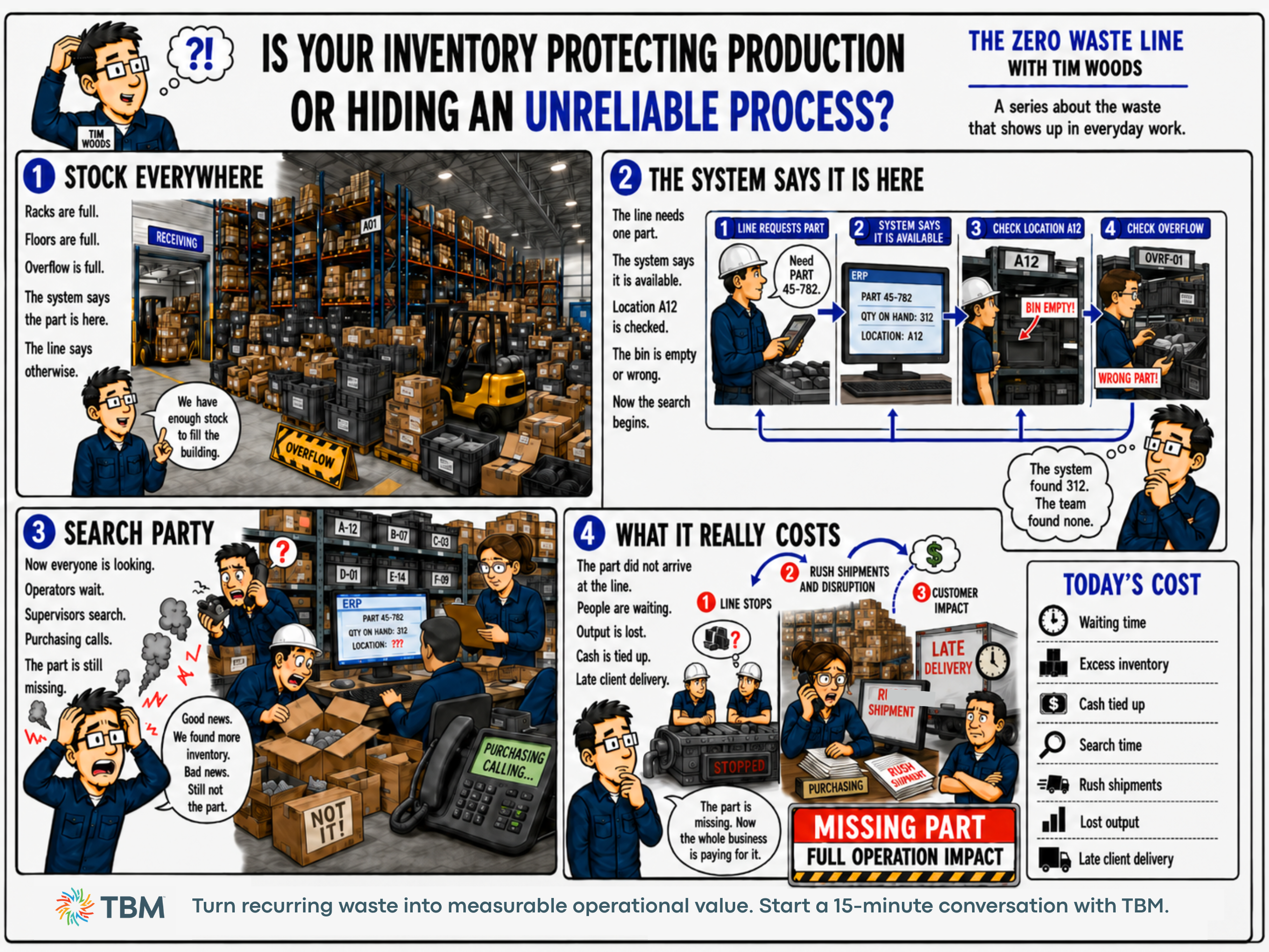
Inventory is often treated as insurance in Lean manufacturing and operations management. It protects production from supplier variability, demand volatility and schedule risk, and gives planners room to respond when equipment, processes or ERP/MRP plans do not perform as expected. Inventory has a role, but problems start when the organisation no longer knows what stock is truly required versus what has accumulated because the production system has learned to depend on it for stability and service level protection.
Excess inventory rarely comes from one decision. It grows through reasonable choices: safety stock raised after unreliable delivery, larger batches due to long changeovers (SMED opportunities), early ordering because supplier lead time is uncertain, WIP building when one process outpaces the next, finished goods produced ahead to cover perceived capacity constraints. Over time, stock becomes the default response to variability in demand planning, production scheduling and supply chain performance.
Each response offers short-term protection. Together, they make inventory the primary absorber of instability. This is why inventory, one of the seven wastes in Lean, should be viewed beyond stock levels or working capital. Inventory is a signal about the reliability of the production system, value stream and material flow. The key question is not only how much inventory a plant holds, but what risk that inventory is protecting against—supplier reliability, changeover time, equipment downtime, forecast error or poor schedule adherence.
A controlled production system does not need perfection. It needs predictability so material flows to takt and customer demand. When predictability weakens, inventory and WIP grow. Long, inconsistent changeovers lead to bigger batches. Reliability issues push teams to run ahead. Variable suppliers increase pressure for safety stock. Frequent schedule changes encourage early release of material. Weak demand planning and poor master production scheduling further inflate buffers across the supply chain network.
Similar behaviour appears when confidence in material control and inventory accuracy drops. If records are wrong, people create protection: supervisors keep extra components at the line, material handlers add unofficial locations, planners inflate planned orders and reorder points because the system data is not trusted.
These actions reduce near-term risk but add complexity. More stock must be stored, counted, moved and controlled. The same SKU appears in multiple locations. Inventory records degrade. Even more stock is then added to offset uncertainty created by the stock itself. This is why cutting inventory targets alone rarely sustains improvement. If variability remains, inventory returns or service, OEE and on-time delivery suffer.
A clear sign inventory is not doing its job is when a plant carries substantial stock yet still experiences shortages, stockouts and expediting. The ERP shows hundreds available. The line requests one. The bin is empty. Teams search overflow, then call supervisors. Purchasing expedites replacements even though the organisation technically owns what it needs. Quantity on hand and true availability are not the same.
A manufacturer can show high inventory value while failing to provide the right part, in the right place, at the right time. Buying more stock rarely fixes the root cause. Questions should focus on system reliability: Are inventory records accurate? Too many storage locations? Is backflushing or issue-transaction discipline weak? Do kanban sizes match actual consumption and takt time? Has the product mix shifted while parameters (min/max, reorder point, safety stock) remain historical? Is obsolete or slow-moving stock masking true availability? These involve planning, production, procurement, material control, warehouse management and leadership discipline.
Inventory absorbs variation. A designed buffer can protect flow from a known bottleneck, constraint or supply risk. Problems arise when buffers become permanent and hide the instability behind them.
Consider two sequential processes. The first runs faster than the second. WIP piles up. Operation one shows high utilisation. Operation two rarely waits. Both look productive, but the inventory is masking imbalance. The root cause could be a bottleneck at the second process, excessive batch sizes, long changeovers, unreliable equipment or local utilisation metrics that conflict with flow. As long as WIP exists, the system can run without confronting the real constraint. Inventory waste stays invisible because it lets the factory keep moving.
Lean manufacturing treats inventory reduction as a flow and stability outcome, not a stand-alone cost cut. The goal is a reliable production system that needs less inventory to meet customer demand and service levels.
Reducing excess inventory once helps working capital and cash flow. Preventing rebuild requires changes in how flow, planning and supply chain performance are managed. These five disciplines support sustained control.
Leaders should explain why each buffer exists, what risk it covers and how the level was set. Safety stock covering supplier lead time is different from stock that accumulated because teams do not trust replenishment or inventory accuracy. Make this a routine review. When supplier OTIF improves, update safety stock. When SMED reduces changeover time, reduce batch size. When schedule adherence strengthens, cut early releases. Keep parameters current with actual performance, demand variability and service policy, not historical defaults.
Optimising individual assets often creates overproduction and extra WIP. A machine can show great utilisation while building parts the next process does not need. From a value stream perspective, that is inventory waste. Link production to downstream consumption, customer demand, takt time and the true constraint. Align batch sizes, sequencing and release rules to support end-to-end flow, leveled production (heijunka) and shorter lead time. Sometimes the right decision is letting equipment wait rather than producing to a utilisation target. Making more that only grows a queue is not productive.
When a part keeps running short, raising safety stock seems fastest. It might protect tomorrow, but it should not be the default answer. Recurring shortages should trigger root cause analysis: inventory accuracy, late replenishment cycles, uncontrolled storage, volatile schedules, supplier lead time changes, incorrect BOMs, or parameters misaligned with current demand. Fix the cause so new stock is not covering the same failure. Understanding the reason before changing levels prevents building excess while the process stays unreliable.
Sustainable inventory depends on equipment reliability, supplier performance, quality, changeovers, production planning and S&OP. These conditions set how much protection is needed. Faster, predictable changeovers enable small batches; higher OEE reduces the urge to run ahead; stronger supplier OTIF lowers precautionary stock; better schedule adherence limits early releases and hot lists; accurate demand planning and ABC segmentation right-size buffers by SKU velocity. The best inventory reductions result from improved capability. The plant does not just set a lower min/max. It makes the old level unnecessary by improving flow and stability.
Inventory should not surface only in month-end working capital reviews. By then, issues have been present for weeks. Include leading indicators in daily and weekly routines: recurring shortages, ageing WIP, abnormal accumulation, inventory accuracy, cycle counting results, replenishment adherence, kanban performance, and deviations from agreed stock levels. These give early warning that flow and service are at risk. The aim is timely problem solving, not another dashboard. Make inventory a shared operating measure across production, planning, procurement, logistics and leadership.
The strongest factories are not the emptiest. They understand why inventory exists, where it is needed, and which operating conditions set its level. Right-sized buffers support on-time delivery, shorter lead time and lower total cost. Removing necessary stock makes operations fragile. Allowing unnecessary stock makes them slow, expensive and hard to control.
The better question is not only how much to remove, but what must become more reliable—suppliers, changeovers, planning, equipment, data accuracy—for the plant to operate well with less. That focus ties inventory to process capability, supplier performance, equipment reliability, demand planning, flow and daily management. When those improve, lower inventory follows as a consequence of Lean, not just a financial target.
TBM partners with manufacturing leaders to address the conditions driving excess inventory: production flow, line balancing, planning and S&OP, material control, equipment reliability, SMED, kanban and daily management. The objective is the right inventory, in the right place, for the right reason. If you carry high stock yet still face shortages, ageing WIP or frequent expediting, start a 15-minute conversation with TBM.