A busy production floor can look productive: operators walking between stations, grabbing tools, reaching for components, printing labels, hunting for scanners and reacting quickly when something is missing. The critical question is whether that motion is required to make the product or if it is consuming capacity without adding value.
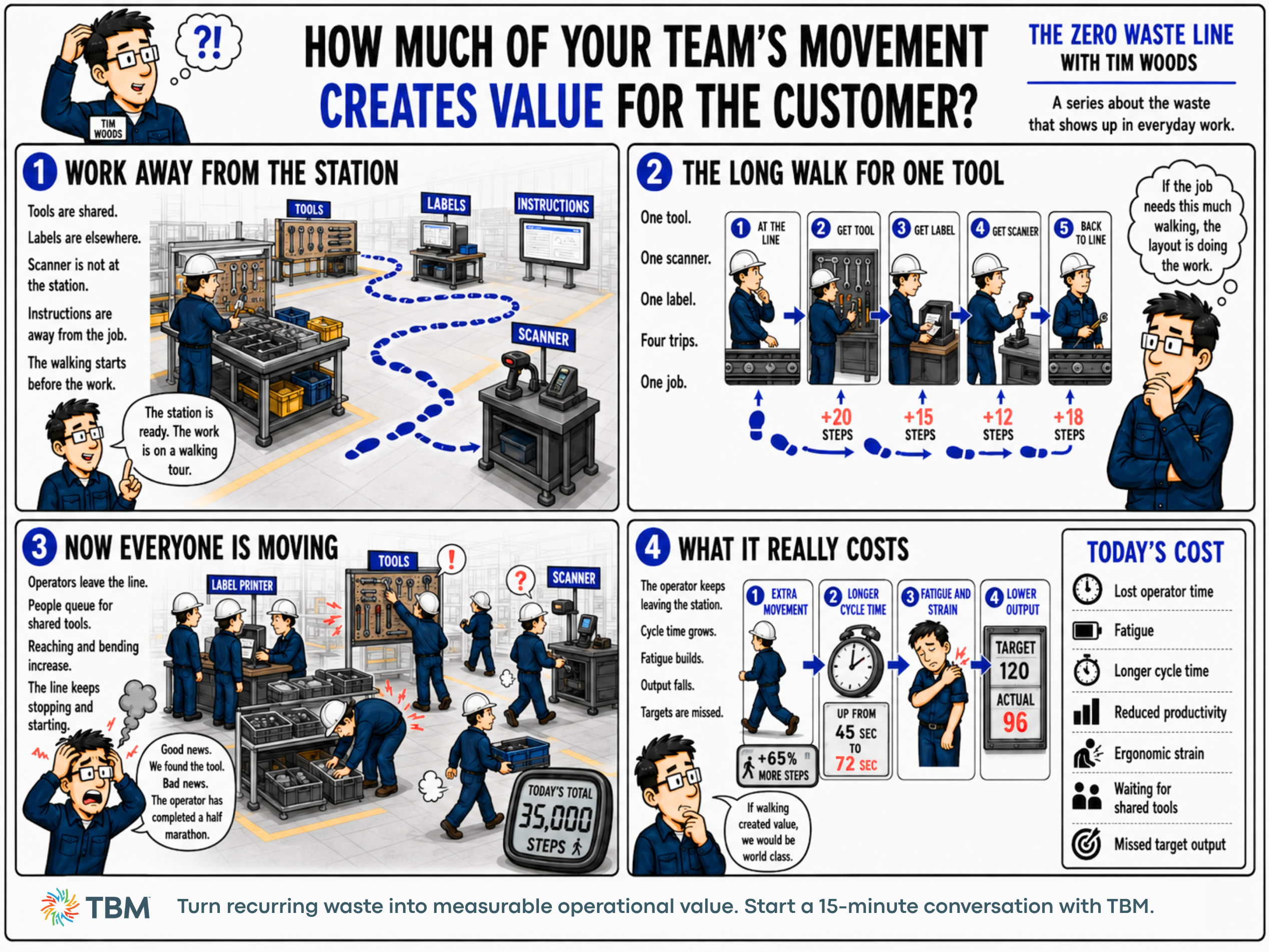
Motion waste in Lean manufacturing is unnecessary movement by people while performing their work. Walking, reaching, bending, searching, lifting, turning or leaving the workstation to fetch tools, labels or scanners all qualify. A few extra steps may seem trivial in a single cycle. But when 20 steps to collect a tool, 15 to retrieve a label and another trip to find a scanner repeat across operators and shifts, those seconds add up and start to erode available capacity. The problem is rarely a lack of effort. Most operators are working hard in processes that require too much walking, searching and reaching to get the job done.
Operators do not choose to spend their day walking the plant. The motion usually comes from how the work and layout are designed. Perhaps tools are shared because there were not enough at launch. A label printer sits centrally to serve multiple lines. Components are stored away from where they are used. Scanners move between operators. Work instructions live on a terminal metres from where the job is performed.
Each decision can make sense alone. Together, they force operators to leave value adding work to find what they need just to continue. Over time, this motion becomes normal. Experienced operators learn where tools are kept, which scanner is typically free and when to walk to the printer ahead of the next build. The organisation becomes skilled at compensating for inefficient design, which is why motion waste often hides in plain sight and does not show clearly in production data.
Consider a job that requires an operator to collect a tool, retrieve a label and find a scanner before returning to the line. Each trip adds only a small number of steps, but the cumulative motion quietly changes the economics of the work.
If a cycle should be 45 seconds and unnecessary walking and reaching push it towards 72 seconds, the issue is not just distance travelled. The additional motion extends cycle time and reduces the number of units completed in the available time.
Across a shift, the difference becomes material. The operator is busy all day, yet the line misses target because too much activity supported the process instead of producing the product. For manufacturing leaders, the takeaway is clear: activity is not the same as productivity, and motion waste directly translates into lost capacity.
Lost operator time is the most visible cost, but not the only one. Repeated walking shrinks the proportion of each cycle spent on value adding tasks. Excessive reaching, bending and twisting increase strain and fatigue. Shared equipment creates queues. Searching introduces variation because one person finds an item immediately while another takes much longer.
These effects cascade into longer cycle times, lower labour productivity, unbalanced lines and missed daily output. Motion waste also triggers other Lean wastes. Walking to a shared tool is motion. If it is in use, the operator waits. If upstream keeps producing, inventory builds. If lost output requires overtime or extra labour, costs rise further. What starts as just a few steps can quickly become a wider capacity and cost problem.
One clear sign of motion waste is a production area where everyone is constantly busy, yet output lags. Operators frequently leave stations. People cross paths. Shared resources cause small queues. Supervisors hunt for missing items. Material gets repeatedly repositioned. Operators reach over equipment or bend because components are not presented correctly Individually, none of these stand out. Together, they consume substantial capacity and mask the true constraint.
It is not unusual to see step counts north of 30,000 in a day. Impressive on a fitness tracker, but less so if thousands of those steps exist because the system failed to bring the right tool, material or information to the point of use.
Go to the workstation and watch several full cycles from start to finish. Capture every instance of walking, reaching, turning, bending, searching or leaving the station. Do not watch only ideal cycles. See what happens when materials run low, shared equipment is busy or items are not immediately available.
Use spaghetti diagrams to visualise travel and quantify distance walked to complete routine work. The goal is to separate motion required by the process from motion created by layout decisions, shared assets and habits.
Position tools, components, scanners, labels and information according to frequency of use and sequence of work. The objective is not just a tidy workstation. A neat bench can still force excess walking and reaching. Design from the operator’s perspective: what is needed first, what is needed next and how often each item is used. Good point of use layout reduces walking, searching and reaching and shortens cycle time.
Centralising a printer, scanner, gauge or special tool may look efficient for asset utilisation. But if multiple operators leave their stations repeatedly to use it, the labour and capacity losses can outweigh the savings.
Measure frequency of use, travel distance and wait time. The right answer may be relocating equipment, changing workflow or adding resources where the capacity and cost calculations justify the investment.
Reaching, bending, twisting and lifting are not just ergonomic concerns. They are signals of poor process design. Components stored below knee height, tools outside the primary work zone or poorly presented materials add seconds to every cycle and increase fatigue across the shift. Improving ergonomics often improves capacity. The best solutions strengthen both wellbeing and productivity at the same time.
Moving a tool closer provides instant benefit, but sustaining it requires defined methods. After redesigning the workstation, update standard work, 5S and replenishment routines so tools and materials remain where the process needs them.
Keep observing. Product mix, volume and equipment change over time, and small additions creep in. A well designed station can slowly accumulate motion again. Make motion waste a daily management focus and a continuous improvement target.
Motion waste matters most when output pressure rises. If a line keeps missing target, adding another operator can feel like the quick fix. Sometimes it is necessary. But first, understand how the current team’s time is spent.
If operators leave the line to find tools, labels, scanners, materials or information, adding headcount may just place another person into the same inefficient system. The stronger move is to improve the work first. Reducing even a few seconds from a cycle becomes meaningful across thousands of cycles, multiple operators and hundreds of days. Reducing walking, searching and reaching directly returns capacity, boosts productivity and lowers cost.
Not all movement is waste. Some motion is necessary for safe, effective production. The aim is not to freeze the operator in place. It is to eliminate motion driven by poor layout, missing tools, inadequate material presentation or weak workplace organisation.
Next time you are on the floor, watch the people as closely as the machines. Where do operators go? What are they looking for? What do they repeatedly reach for? Why do they leave the workstation? If you were designing this job today, would you deliberately include those movements?
After more than 35 years partnering with manufacturers, TBM consistently uncovers capacity by removing walking, searching and reaching from everyday work. Small, targeted changes in how work is organised shorten cycle times, improve labour productivity and ergonomics, and unlock more output from existing assets.
TBM works with manufacturing leaders and frontline teams to identify unnecessary motion, redesign workstations and standard work, and convert improvements into measurable gains in capacity and productivity. If your teams are always moving but output still lags, schedule a 15 minute conversation with TBM to see how reducing walking, searching and reaching can return capacity to your line.