Skills waste is often called the eighth of the wastes of Lean manufacturing, added to Taiichi Ohno’s original seven as lean thinking spread beyond Toyota. It happens whenever the knowledge, experience and ideas of the people doing the work are left unused. Unlike overproduction or excess inventory, it leaves nothing on the floor to count. There are no surplus pallets and no scrap bin to weigh. The cost shows up elsewhere: in machines that wait for one expert, in problems that are solved again and again, and in capable people who stop offering what they know. Skills waste in lean manufacturing is easy to overlook because the people are present and busy. What is missing is a system that lets them contribute.
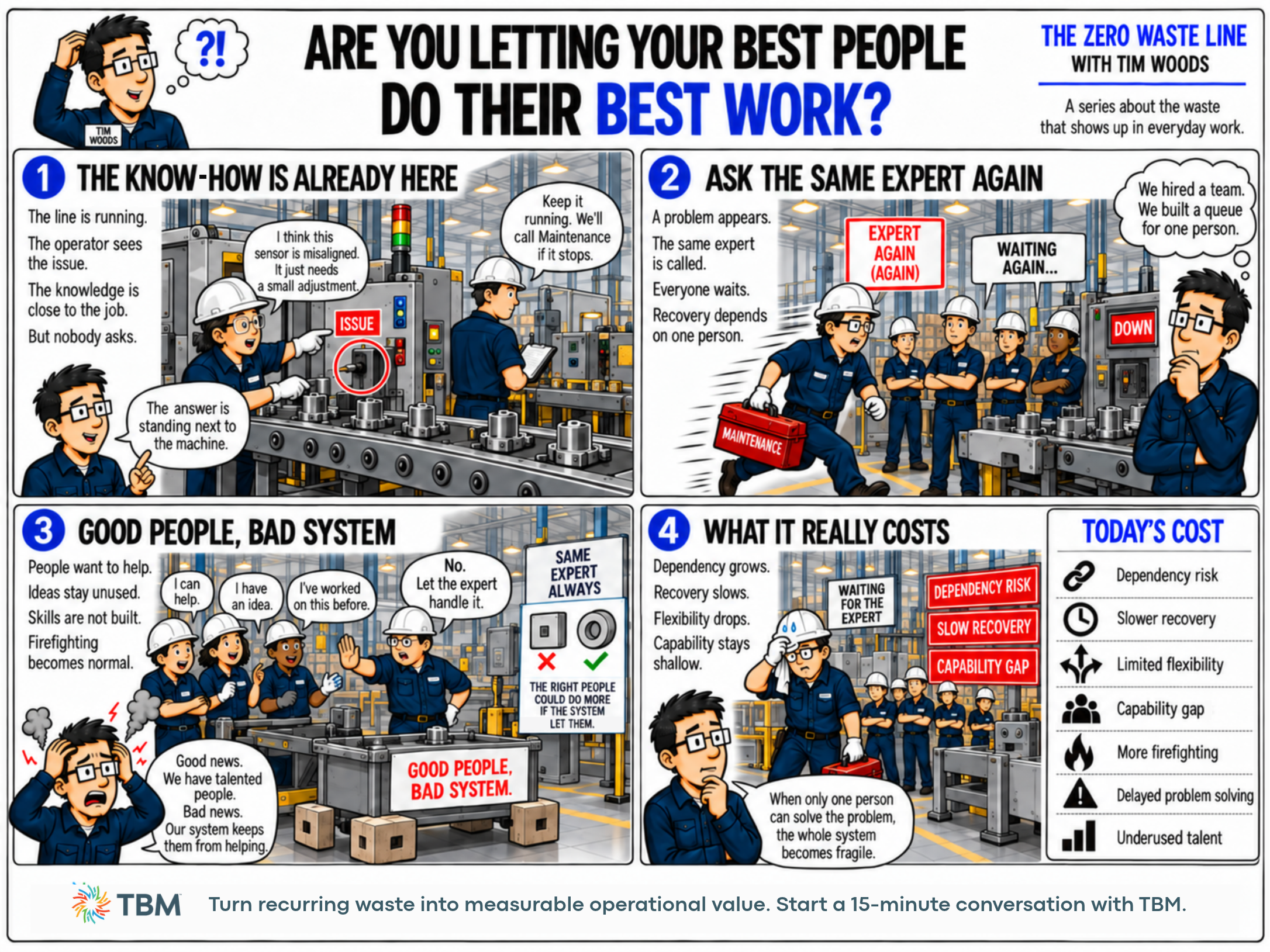
The line is running. An operator notices a sensor that looks misaligned and knows it needs a small adjustment, because he has seen it before. The instruction he receives is to keep the line running and call Maintenance if it stops. Nobody asks what he thinks, so the knowledge closest to the job stays where it is. Later that shift the sensor fails, the line stops, and a problem that could have been fixed in minutes becomes a breakdown.
When the line goes down, the same maintenance technician is called. He is called because he is reliable, and because the last ten times it was him. Everyone else waits. Over time, recovery stops depending on the process and starts depending on one person’s diary. The site has hired a team, yet in practice it has built a queue for a single expert. If that person is on leave, on another line or close to retirement, the whole operation inherits the risk.
The people waiting are rarely short of ability. One has an idea. Another has fixed the same fault at a previous site. A third simply offers to help. The answer each time is the same: let the expert handle it. Nobody in this scene is behaving badly. The system rewards waiting for the specialist, so that is what happens. Talented people stay on the sidelines, ideas go unused, skills are never built and firefighting becomes the normal way of working.
Common causes include roles defined so narrowly that operators are expected to run machines and nothing more, problem solving reserved for maintenance or engineering, no structured cross-training or skills matrix, improvement ideas that are collected but never answered, and team leaders measured on output alone, with no target for the capability they build. Each of these makes it easier to call the expert than to develop someone new. They are the first places to look when working out how to make better use of employee skills on the shop floor.
Skills waste matters more than its invisibility suggests, because it decides how long every other waste survives. The people closest to waiting, defects, motion and transport are the first to see them. When they are not asked, or not trusted to act, those wastes stay in place.
The evidence on what happens when ideas go unanswered is consistent. In SafetyCulture’s Feedback from the Field study, run with YouGov among 1,019 US frontline managers and published in June 2026, only 54% of those who submitted improvement ideas said they were implemented. When suggestions were not acted on, 51% said inefficient processes persisted, 38% stopped proposing ideas and 25% said they were more likely to quit. Closer to home, Gallup’s State of the Global Workplace 2026 puts employee engagement at 10% in the UK and 12% across Europe, against 20% globally.
When a line stops, calling the expert is often the fastest fix in the moment, and sometimes it is the right one. The problem is what it leaves behind. Each time the same person solves the same fault alone, the operation becomes more dependent on them. The stronger approach is to turn that person’s knowledge into something the whole team can use: write it into standard work, pair the expert with a trainee on every call-out, capture recurring fixes as one-point lessons and give the expert time to teach as part of the role.
This becomes more urgent as experienced people approach retirement. A 2025 survey of 1,500 frontline managers and employees in the US, UK and Germany by Flip found that 72% of managers in retail and manufacturing were not confident they could retain the knowledge lost to retirement, while 59% of frontline workers over 55 planned to leave the workforce within five years. Knowledge that lives in one person’s head leaves with them.
When a site leans too heavily on a few experts, the instinct is to recruit more of them. Sometimes that is justified, but the labour market makes it slow and expensive. Make UK’s Industrial Strategy Skills Commission estimates that 55,000 long-term vacancies in UK manufacturing cost the economy £6bn in lost output every year, and the Department for Education’s Employer Skills Survey 2024 found that 34% of manufacturing vacancies were hard to fill because applicants lacked the skills, qualifications or experience required. Before adding headcount, it is worth understanding how much capability is already on the payroll and going unused. Developing the people already on site is frequently a faster and cheaper route to resilience than waiting for the right candidate to apply. For an example of a business building that capability from within, see how Gnosis by Lesaffre built an internal engine for change.
Skills waste is easy to miss because everyone looks busy. The expert is in demand, the team is waiting and willing, and the line eventually restarts. Yet each time the same person is called, the operation becomes a little more fragile and the people around them learn a little less. The next time a problem stops the line, ask not only who can fix it, but who else could have, and what stopped them. That question is where reducing skills waste in lean manufacturing begins, and where good people start working inside a system that lets them do their best work.
If your operation depends on a few people to keep running, or you want to understand what unused capability is costing in downtime, recovery time and risk, talk to TBM. We can help map where your dependencies sit and build the skills to remove them. Start a conversation with TBM.