There is nothing unusual about seeing forklifts moving constantly through a manufacturing plant. In fact, a busy warehouse, full staging areas and frequent material movements can create the impression of an operation working at pace. The more important question is whether all that movement is helping the factory produce more, or whether some of it has simply become part of the way the operation has learned to function.
Transportation is one of the seven wastes of Lean manufacturing, but understanding it simply as unnecessary material movement understates its importance. In a well designed production system, material moves in response to demand and progresses towards the next value adding activity with as little interruption as practical. When material continually travels between production, staging areas and central storage, the movement is often telling us something more fundamental about the way the value stream has been designed and managed.
The forklift is often the easiest thing to see. It is rarely the first thing we would try to fix. Excessive transportation can originate in the physical layout of the plant, but it can equally be created by production planning, batch policies, inventory decisions, poor material presentation, unreliable replenishment or weak synchronisation between processes. Equipment may have been installed according to available floor space rather than product flow. Production departments may have been optimised individually while material moves repeatedly between them. Large batches may be produced because changeovers are difficult, creating work in progress that then needs somewhere to go. Central warehouses may provide excellent inventory control while unintentionally increasing the distance between material and the point where it is consumed.
These are very different operational problems, even though they can all create the same visible result: more material movement. This distinction matters because reducing transportation waste is not simply an exercise in shortening forklift routes. If the underlying production system continues to generate unnecessary movement, making transportation faster merely makes the waste more efficient. The management challenge is to understand why the movement exists and whether the operation could perform differently without it.
Factories rarely set out to create poor material flow. It develops gradually. A new machine is installed where space is available. A product range expands. Volumes increase. Another storage location is introduced. A temporary staging area becomes permanent. Additional forklifts are added because the existing fleet is struggling to meet demand. Over time, each decision may be rational in isolation while the overall value stream becomes progressively more complex.
This is one reason transportation waste can persist for years. People become very good at operating within the system they have been given. Forklift drivers learn the fastest routes. Supervisors know which material needs to be expedited. Operators recognise which components they need to request early. Planners build additional time into schedules. The organisation develops routines that compensate for poor flow, and those routines can eventually become indistinguishable from normal work.
From an executive perspective, this is where the issue becomes particularly relevant. An operation may appear fully utilised because people and equipment are constantly active, while a meaningful proportion of that activity is supporting internal complexity rather than customer output. High activity is not necessarily high productivity.
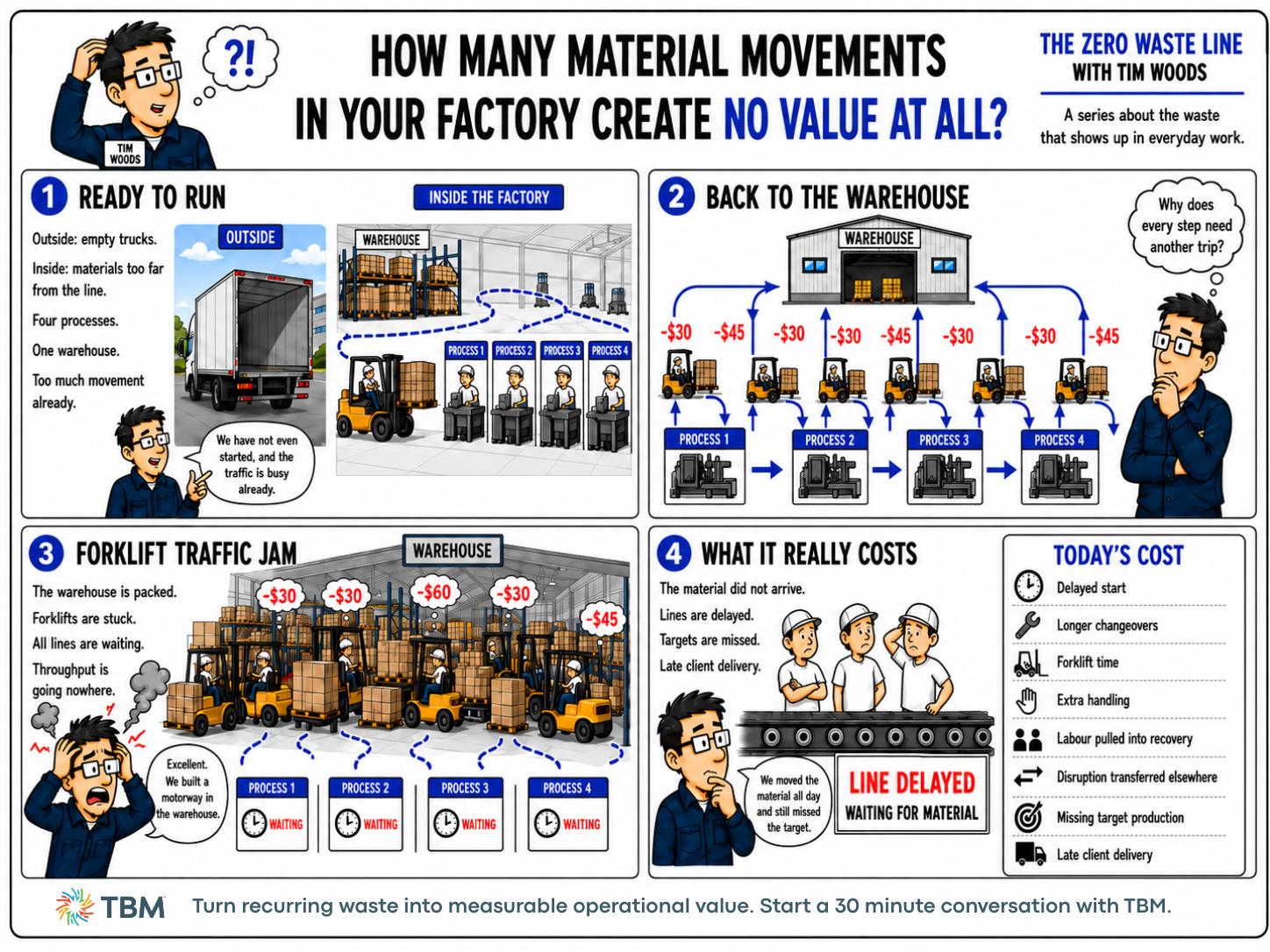
Looking only at transportation cost can significantly underestimate the opportunity. Suppose material completes one operation, returns to a warehouse, waits to be stored, waits again to be retrieved and is subsequently transported to the next production process. The direct cost of the forklift movement may be relatively modest. The larger cost sits around the movement. Additional work in progress occupies space and ties up working capital. Material is handled multiple times. Production becomes dependent on internal logistics availability. Components can arrive later than required. Operators wait. Schedules are disrupted. Supervisors intervene. Additional handling creates opportunities for damage and quality problems.
Transportation therefore has a close relationship with several of the other seven wastes of Lean manufacturing, particularly waiting, inventory, motion, overproduction and defects. This is why we rarely assess transportation as an isolated efficiency measure. We are interested in its effect on the performance of the complete value stream. The question is not simply how much does it cost to move this pallet. The stronger management question is what does this movement cause elsewhere in the operation?
Some of the most valuable observations in manufacturing remain remarkably simple. Follow a representative product through the factory and observe what actually happens to it. Where does the material arrive? Where does it wait? How many times is it handled before production is complete? How often does it return to storage? How far does it travel between processes? What triggers each movement? How much elapsed time is associated with productive transformation and how much is associated with transportation, storage and waiting?
A spaghetti diagram can help make the physical route visible, but the real insight comes from combining that observation with operating data. Touch count, travel distance, material dwell time, work in progress, line side availability, internal logistics labour, schedule attainment and throughput can begin to show the economic impact of the current flow.
This is where experienced shop floor observation matters. A process map may suggest that material moves logically from one operation to another. Walking the process can reveal a very different reality. The material may technically progress from Process 1 to Process 2, but only after being wrapped, transported, scanned, stored, retrieved, transported again, staged and finally presented to the next operation. On paper, that may appear to be one process transition. Operationally, it represents multiple opportunities for delay and cost.
Transportation becomes particularly important when an operation is under pressure to increase output. When demand rises and production struggles to respond, the natural reaction can be to add labour, forklifts, warehouse space, equipment or shifts. Sometimes additional resources are absolutely necessary. But the quality of that investment decision depends on understanding how effectively the current operation is using the capacity it already has.
If production equipment is waiting because material is unavailable, adding another machine does not solve the material flow problem. If forklifts are congested because every production stage depends on repeated transfers to and from central storage, adding another forklift may provide short term relief without changing the underlying operating model. If warehouses are full because large batches are produced ahead of actual consumption, additional storage capacity can accommodate the inventory without addressing why it exists.
For senior manufacturing leaders, this is the point at which Lean thinking becomes a capital allocation issue, not simply a continuous improvement exercise. Before investing in additional capacity, it is worth establishing how much existing capacity is being consumed or constrained by the way material currently moves through the operation.
The next time you walk through a manufacturing facility, watch the forklifts, but do not stop there. Look at what they are carrying, where the material has come from, where it is going and what will happen when it arrives. Look at the inventory waiting between processes and ask why it needs to be there. Look at the production lines and ask how frequently their performance depends on someone moving material at exactly the right time.
Then consider a more difficult question: if we were designing this value stream today, would we deliberately design all of these movements into it? That question gets much closer to the purpose of Lean manufacturing.
After more than 35 years working alongside manufacturing organisations, our experience is that the largest opportunities are not always found in the most sophisticated analysis. Often they begin with observing what happens every day, challenging what has gradually become accepted and reconnecting operational activity with the flow of value to the customer.
Transportation is one of the seven wastes. But when unnecessary movement becomes embedded in the operating system, its consequences can reach considerably further, influencing productivity, capacity, working capital, lead time and customer performance.
TBM works directly with manufacturing leadership teams and frontline operations to identify the causes of poor flow, remove recurring waste and translate improvement into measurable gains in productivity, capacity and delivery performance. If your operation is moving more material than the output would suggest, start a conversation with TBM.